Vol. 2: Accuracy vs. Precision in Talent Acquisition
- Talent Marksmanship
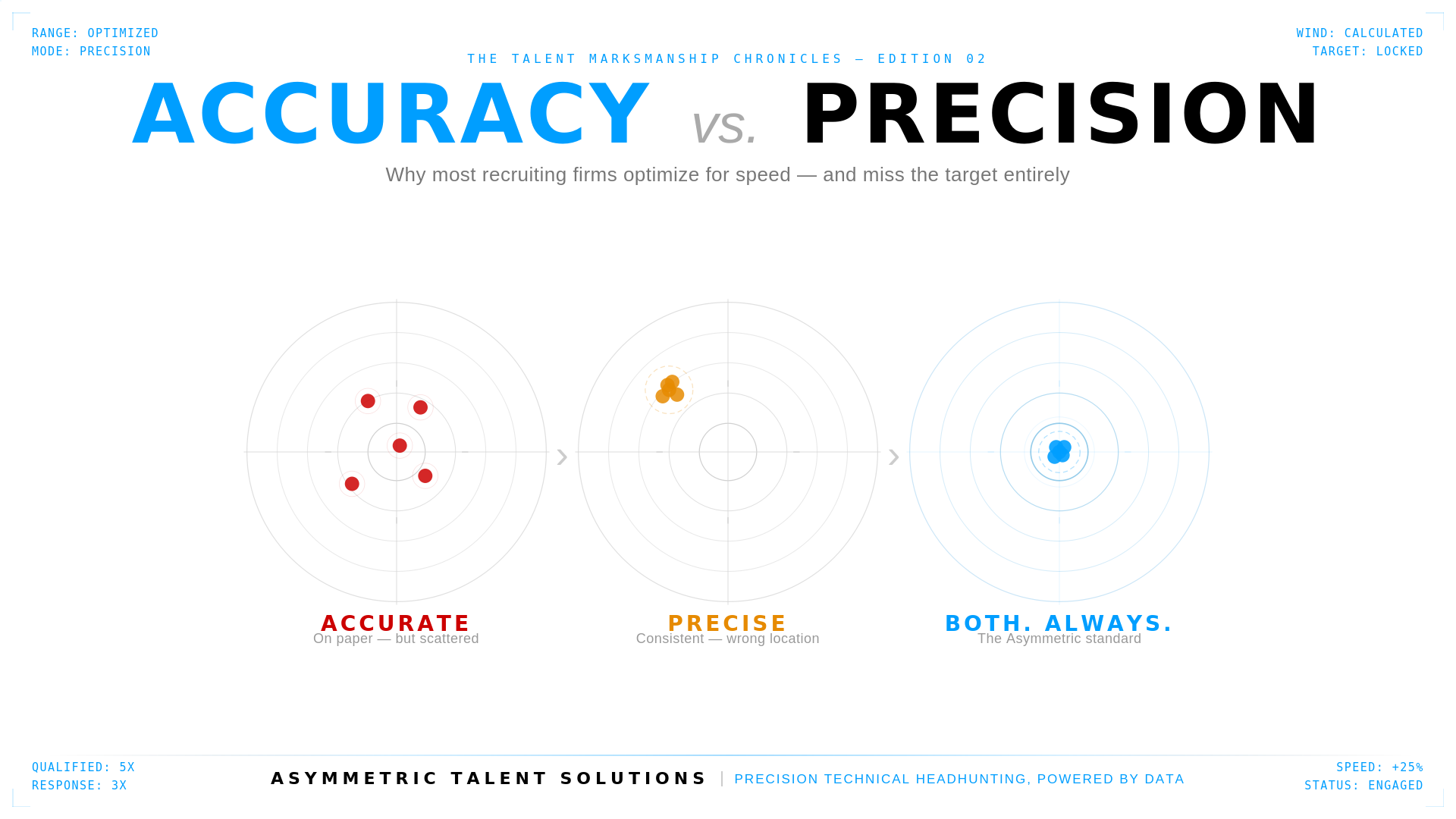
Picture two shooters on the range. The first shooter fires five rounds and puts all five on paper but they’re scattered across the target: one high left, one low right, one near center. He hit the target. He’d call that success. The second shooter fires five rounds and drives them into a group you could cover with a quarter, consistently, in the same spot, every time. Ask any competitive marksman which shooter you’d want next to you in a match, and the answer is immediate.
Now ask yourself which one is running your talent searches.
This distinction between accuracy and precision is one of the most misunderstood concepts in competitive shooting, and it maps perfectly onto one of the most persistent failures in talent acquisition.
The Definition That Changes Everything
In marksmanship, accuracy and precision are not synonyms. They describe two entirely different things.
Accuracy means hitting the target you’re aiming at. Precision means producing consistent, repeatable groupings regardless of where those groups land. A shooter can be accurate without being precise (lucky hits, scattered results) and precise without being accurate (tight groups, wrong target). Championship performance demands both: the ability to put consistent groupings exactly where they need to go, on demand, under pressure.
Most recruiting firms don’t understand this distinction. And it’s costing their clients dearly.
What This Means for Your Hiring Process
In talent acquisition, accuracy is about hiring the right person for the right role. You made the correct call, the candidate fits, they perform, the business moves forward. That’s accurate. It matters enormously.
But precision is something different. Precision is the repeatable, systematic process that produces quality outcomes consistently not just when conditions are ideal, not just when a search happens to be in a familiar market, not just when luck runs in your favor. Precision is what separates a firm that gets it right once from a firm that gets it right every time.
Most staffing firms optimize almost exclusively for speed. They fire rounds as fast as they can load them, trusting that volume will produce results. And sometimes it does. They get an accurate hit on the right candidate, at the right time. But ask them to repeat it, and the scatter returns. The process that worked last quarter fails this quarter. The approach that succeeded in one market falls apart in another. There’s no tight group. There’s no system. There’s only the hope that the next five rounds will find the paper.
This is not a criticism of effort. Most recruiters work hard. The problem is that without a precision-oriented system, all that effort produces inconsistent outcomes. In shooting terms: high rate of fire, poor groupings.
Why Speed Without Precision Is a Trap
Here’s what makes this distinction critical: accuracy without precision looks fine right up until it doesn’t. You make a few good hires, build some confidence, and assume the system is working. Then conditions shift, the market tightens, the role gets more specialized, a key stakeholder changes their requirements and suddenly the wheels come off. Because there was no system. There was only a streak.
The best shooters know that a tight group tells you something a scattered group never can: it tells you exactly what to fix. If your rounds are landing consistently in the same wrong place, you have a zeroing problem, and zeroing is solvable. You make a precise mechanical adjustment, and your precise group moves to where it should be. But if your rounds are scattered everywhere, you have nothing to work with. No feedback, no data, no path to improvement. It’s a fundamental lack of capability in the system itself.
The same logic applies to recruiting. A firm with a repeatable, disciplined search process, one that consistently delivers qualified candidates through a documented methodology, can diagnose and correct problems quickly. Miss on a hire? They can identify exactly where in the process the deviation occurred and close it. A firm operating on intuition and volume has no such mechanism. Every missed search starts from zero.
The Asymmetric Approach: Both, Always
At Asymmetric Talent Solutions, we’ve built our methodology around the principle that you should never have to choose between accuracy and precision and that accepting one without the other is simply not good enough.
Our 100% success rate on committed searches is not an accident of circumstance or a fortunate run of favorable markets. It is the direct output of a precision-oriented system that is calibrated before we ever begin sourcing. Before we engage a single candidate, we’ve already completed the equivalent of a thorough pre-match setup: defining exactly what the target looks like, mapping the full addressable talent pool (which typically runs 5x larger than what most firms identify), and aligning every stakeholder on what a successful outcome requires.
That upfront investment in process precision is what makes accuracy reliable rather than coincidental. We’re not shooting fast and hoping. We’re establishing our zero, confirming our fundamentals, and then executing with the kind of disciplined consistency that produces tight groups, search after search.
The results speak to both dimensions: 3x higher candidate response rates reflect accuracy in targeting and messaging; 25% faster finalist delivery reflects precision in process execution; and the 100% success rate reflects what happens when you refuse to let either one slide.
The Question Worth Asking
If someone asked you to describe the process your current recruiting partner uses to identify, engage, and qualify talent, could you describe it? Could they? If the answer involves phrases like “we leverage our network” or “we know the market,” that’s not a process. That’s a shooter telling you they’re a good aim without being able to show you the proof.
Championship recruiting, like championship shooting, isn’t about the moments of brilliance. It’s about the system that makes those moments repeatable.