Why Contingent Agencies Keep You Settling, An Unapologetic Indictment Of The “No Win, No Fee” Model
- Blog
The contingent staffing model is not a service. It’s a gamble. And the house wins far more often than you do.
There is a problem so deeply embedded in how companies hire that most leadership teams have stopped questioning it. They’ve adapted to it. Scheduled around it. Budgeted for it. Every single time they do, they settle.
This is not opinion dressed as insight. This is a documented case for why the traditional agency model is broken, what the data says about its outcomes, and why I built a fundamentally different approach from the ground up. One that produces results the contingent model is structurally incapable of delivering. One that is operational. One that has never failed a committed search (every search we accept is a retained, structured engagement, not a job order).
It’s time to stop settling.
The Model Was Never Built for You
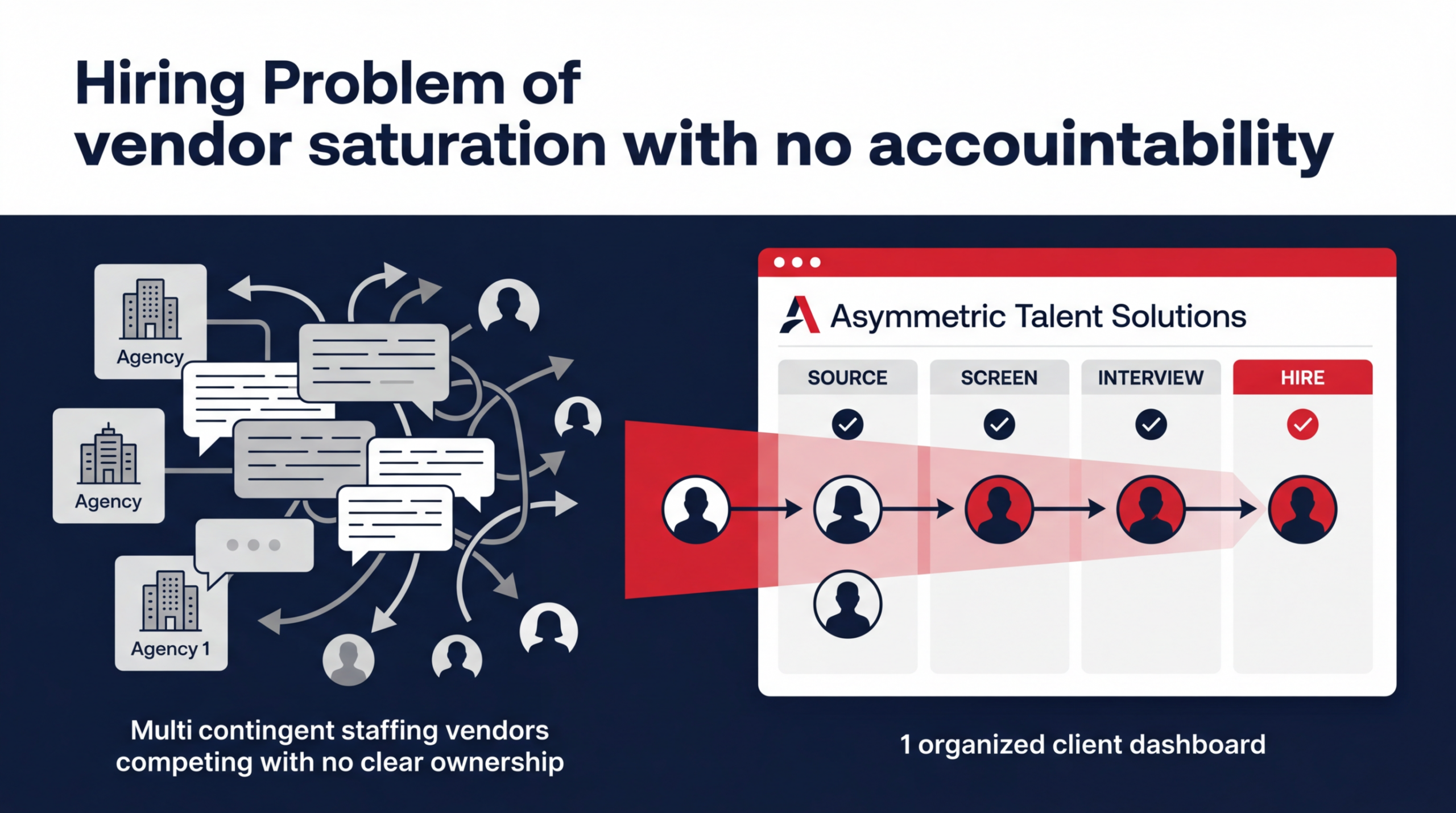
Ask yourself something honest: when was the last time a contingent recruiter told you how many other roles they were working simultaneously with yours? Have you ever had any visibility into how they’re executing the work you’ve asked of them?
Most buyers don’t care how the work they’re paying for gets completed, just that it gets done at their expectation level. That’s where the fundamental difference lives. When it works, it feels good. When it doesn’t, it’s not surprising. It’s expected. It’s the unacceptable norm.
Back to the volume of roles. The number matters.
The contingent model operates on volume and speed, not depth and outcomes. A contingent agency recruiter is actively working 10 to 15 open roles at any given moment, all at no cost to them until placement. Every new role added to their desk introduces direct competition for the same hours, the same outreach capacity, and the same attention your hire deserves. Your search gets ranked. If it’s niche, if it’s passive, if it’s senior, it goes to the bottom of the pile. The financial risk of investing real time in a difficult search, without a guarantee of payment, is simply too high for their model to absorb.
We’ve written about this directly. The structural incentive of the contingent model means your vendor is making decisions about your search that you will never see and that were never made in your favor. We explored the mechanics of this in our article Getting Graded on Your Vendors’ Whiteboard, because the whiteboard is real, and your role is on it.
This is not laziness. This is math. The math works entirely against the hiring manager.
The result is predictable. Contingent agencies fish in the same 30% of the market: the candidates actively looking, the ones already in circulation, the profiles already in everyone else’s database. They send the same templated LinkedIn messages to the same visible pool of talent. They hand you a stack of resumes and call it a pipeline. If the role is hard, niche, or requires any depth of engagement with passive talent (the 70% of the global workforce that will never respond to a job posting), those candidates are never touched. Never identified. Never engaged. Never presented.
We documented the damage that approach creates in Over-Reliance on Inbound Applicants and Job Boards and Limited Access to the Full Addressable Talent Market. The data has always been there. The agency model just never had to answer for it.
You didn’t know you were making a decision without 70% of the available information. But you were.
The Data Has Been Speaking. Nobody Translated It.
The numbers behind the contingent model are not a secret. They are simply inconvenient and rarely placed in front of the buyers who fund the system.
The industry fill rate for contingent staffing on professional and specialized roles runs below 20%. That means four out of every five searches conducted by contingent agencies, on the kinds of roles most leadership teams actually care about (technical, senior, niche, confidential), do not result in a placement. Not occasionally. On average. Four times out of five, you’ve opened your search, exposed your brand to the market, consumed your team’s time, waited, followed up, and ended up exactly where you started.
The broader executive search industry carries a more favorable track record, but even here, over 40% of executive searches fail according to the Executive Search Information Exchange. The industry average time to shortlist ranges from 8 to 16 weeks. For executive-level roles, the average time to fill runs 90 to 120 days, sometimes reaching 150. For C-suite positions, the process can extend to four to eight months.
Most hiring leaders have experienced this. They just didn’t know the number had a name.
The cost of a bad hire is not abstract. SHRM research puts the cost of replacing a poor hire at up to five times that employee’s annual salary when factoring in recruitment, training, and lost productivity. The U.S. Department of Labor places the minimum cost floor at 30% of first-year salary. Forbes research has quantified cumulative hiring failure costs at up to $240,000 per bad hire. These are not edge cases. These are the systemic outcomes of a systemic problem.
We broke down the full issue of inefficiency and wasted client time in Inefficient Hiring Processes, Excessive Client Time Commitment, and Unreasonable Time-to-Hire. In each case, the root cause is the same: a model that was never architected to be fast, precise, or accountable.
The cost of continuing to do what you’ve always done is no longer theoretical. It is documented.
How We Stack Up
Before going further, here’s what the data looks like side by side.
| Metric | ATS | Industry Average |
| Time to Shortlist | 3-4 weeks | 8-16 weeks |
| Search Completion Rate | 100% | ~60% retained / <20% contingent |
| Talent Pool Depth | 500-800 profiles | 50-100 profiles |
| Market Penetration | 60-70% | 15-20% |
| Cold Outreach Open Rate | 60% | 15-25% |
| Client Time Required | 3 hours per search | 15-25 hours |
These aren’t projections. They’re a performance record. We’ll come back to the specifics.
The Language Itself Tells the Story
Words matter. They reveal intent. They reveal limits.
When a contingent agency accepts a new search, they take a “job order.” They write your hiring need on a whiteboard alongside 10 or 14 others. They rank the list by probability of quick placement and acceptable fee risk. If your role is “tough,” it gets deprioritized. If the market is passive, they shrug and send you whoever responded to a generic message.
We don’t take job orders. We don’t grade your needs against a whiteboard of competing priorities. We don’t talk about ‘filling seats.’
We design, test, and continuously optimize a talent acquisition ecosystem engineered from the ground up for one purpose: giving our clients access to every qualified candidate in their market. Without limitation. Without compromise. Without settling.
The language distinction is not cosmetic. It reflects something functional: a different mindset, a different infrastructure, and a different commitment to what the work actually demands. We wrote about the exact mental model shift required in Legacy Recruiting Models, and why most firms are still running playbooks designed for a labor market that no longer exists.
Traditional recruiting is a leap of faith. We’re a paper trail.
The Confession Most Firms Won’t Make
Before the current version of Asymmetric Talent Solutions was built, we operated inside the contingent model. We were eager to demonstrate our approach. Eager to be of service. Our efforts remained the same across every search.
The difference, almost every time, was a lack of commitment and accountability from the people placing the order.
Our personal fill rate as contingent recruiters was 28.5%. Let’s be direct about what that means: 28.5% was above average. The industry contingent fill rate for professional and specialized hires runs below 20%. We outperformed the model we operated in, and we still failed to deliver on nearly three out of four searches.
That number didn’t represent a bad stretch or a difficult period. It represented the model’s ceiling.
In virtually every one of those failed searches, we had a candidate in final or offer stages during the engagement. The work was done. We were at the finish line. The system still failed.
So, what killed those searches? Here’s what hiring leaders almost never say out loud:
- An executive resigned. Priorities shifted overnight. The budget got pulled. The role got restructured. A VP decided, at the eleventh hour, that the org chart looked different than it did three weeks ago. This happened after the verbal offer was asked to be extended, after time and trust had been invested on all sides.
- They promoted internally. Not because the internal candidate was evaluated and selected through a rigorous process, but because they were familiar. Because it was easier. Research published in the Journal of Accounting Research confirms what search professionals have seen for decades: managers routinely promote internal candidates over more qualified external ones, not based on capability, but on perceived effort and relationship familiarity. That internal decision was often being considered in parallel with the external search, without anyone saying so.
- A referral got “a chance.” Someone on the leadership team knew someone. A name came in through a side door. The organization defaulted to what felt safer rather than what the data supported. Referral hires are selected at far higher rates than their qualification signals warrant, and the external search, already in progress, is quietly abandoned.
- They went with what was easy. Not the best available person in the market. Not the candidate the data supported. The one already in hand. The convenient choice dressed up as a final decision.
This is what 71.5% of our searches in the contingent model looked like. Not a talent shortage. Not an impossible brief. A client who, at the critical moment, chose proximity over precision, and had no structural reason not to, because the contingent model gives them none.
The model doesn’t just tolerate eleventh-hour decisions. It enables them. There is no commencement fee, no structured steering process, no documented commitment, no shared accountability. When the client walks, the agency moves to the next role on the whiteboard. The candidate who cleared every bar might not even get a call. The client gets no data on what they walked away from. Next quarter, they open another search.
We published an entire article on exactly this dynamic in Misaligned Incentives Causing Recruiters to Cut Corners. The misalignment isn’t accidental. It’s structural and the proper Structure Doesn’t Crack Under Pressure.
The contingent model was not built to succeed. It was built to move fast enough that clients would keep feeding it roles, accept the occasional placement as a win, and never stop to calculate what the repeated failures actually cost them.
The Finish Line That Moves
The second reason searches die at the end has nothing to do with client decisions. It has everything to do with time, and the talent market’s complete indifference to a slow process.
Top candidates are not waiting. Research consistently cited across the talent acquisition industry places the window for the top 10% of candidates at 10 days or fewer from the moment they become available. A 2025 analysis placed it plainly: the best candidates accept offers within 10 to 14 days. The average corporate hiring process takes 42. That math has never worked. Nobody in the contingent model is incentivized to say so.
SHRM data reinforces the urgency. When a hiring process extends beyond 30 days, top candidates are 70% more likely to accept a competing offer before the original employer reaches the table. Nearly one-quarter of qualified candidates lose interest if they don’t hear back within one week of an initial interview. Another 46% disengage if there is no meaningful update within one to two weeks.
This isn’t candidates being impatient. This is candidates being rational.
The strongest professionals in any market have leverage. They have options. They entered a conversation because someone reached them with precision and made a compelling case. When that process stalls, when scheduling drags, when another approval is needed, when another week of silence follows, they don’t wait. They accept the offer from the firm that moved like the hire mattered.
Research from Grey Search shows that 48% of candidate drop-off occurs between the first and second interview. That is precisely the window where internal scheduling and stakeholder availability create the longest dead air. The Talent Board’s Candidate Experience Benchmark Research identified the three leading reasons candidates voluntarily exit a recruiting process:
- Their time was disrespected
- The recruiting process took too long
- Compensation did not meet expectations
Notice what is not on that list. The role wasn’t interesting. The company wasn’t compelling. The candidate changed their mind. The search failed because of how it was run, not what was being offered.
We addressed this problem in When Perfect Candidates Go Poof where candidate drop-off is caused by unclear communication or long processes. The dropout is predictable. The causes are documented. They are entirely preventable with the right infrastructure.
Now layer this on top of the contingent model. A recruiter presents a qualified candidate. The client, managing 14 other priorities and waiting on a stakeholder who is traveling, takes a week to schedule an interview. Then another week to debrief. Then another week to decide. By the time an offer is being drafted, the candidate has accepted a role with a company that moved in 12 days.
The recruiter gets no fee. The client gets no hire. The candidate gets no call. The agency moves to the next role on the whiteboard.
This is the finish line that moves. Not because the talent wasn’t there. Not because the search wasn’t executed. Because the model provides zero structural incentive to move with the urgency top talent demands.
We addressed decision velocity directly, what it is, what it costs, and how to build it, in our Decision Velocity article. The answer isn’t rushing. It’s being ready. Being ready is what the right process makes possible.
What a Surgical Search Actually Looks Like
Every search begins the same way: with absolute clarity.
Before a single candidate is identified, we gain total alignment on what success looks like. Not a vague job description, but minimum viable criteria, compensation benchmarks, market landscape intelligence, and competitive context. No search begins until both sides are completely aligned. Most recruiters take a brief and start sending messages. We take a brief and architect a strategy.
We documented why that upfront investment changes everything in The Discovery Black Hole and Aligning Candidate Criteria Through Proper Discovery. The firms that skip this step don’t know what they’re looking for. They just start moving and hope the destination appears.
From that foundation, we map the entire addressable talent pool. Not a portion of it. Not the convenient portion. All of it. Our talent pools range from 241 profiles to nearly 1,200, with an average of 500 to 800 qualified, addressable profiles per search. The industry average talent pool depth sits at 50 to 100 profiles. This is not a wider version of the same search. This is a categorically different one.
We’ve written extensively about why talent mapping is not a sourcing tactic but a strategic lever, in Talent Mapping as a Strategic Lever and Talent Mapping as a Strategic Weapon. The difference between a 50-profile pool and a 500-profile pool is not effort. It is infrastructure, methodology, and the willingness to go where the contingent model will never go. Confidence feels powerful in hiring until the stakes spike and the variables multiply.
After mapping comes engagement: multi-channel, personalized outreach at scale. Not templated messages. Not recycled sequences. Genuine, targeted, intelligent outreach that produces 3x the response rate of industry norms. Our cold email open rate is +60%, against an industry benchmark of 15 to 25%. The mechanics behind that output are detailed in Genuine Multi-Channel Messaging at Scale and Limited Outreach Volume and Candidate Penetration.
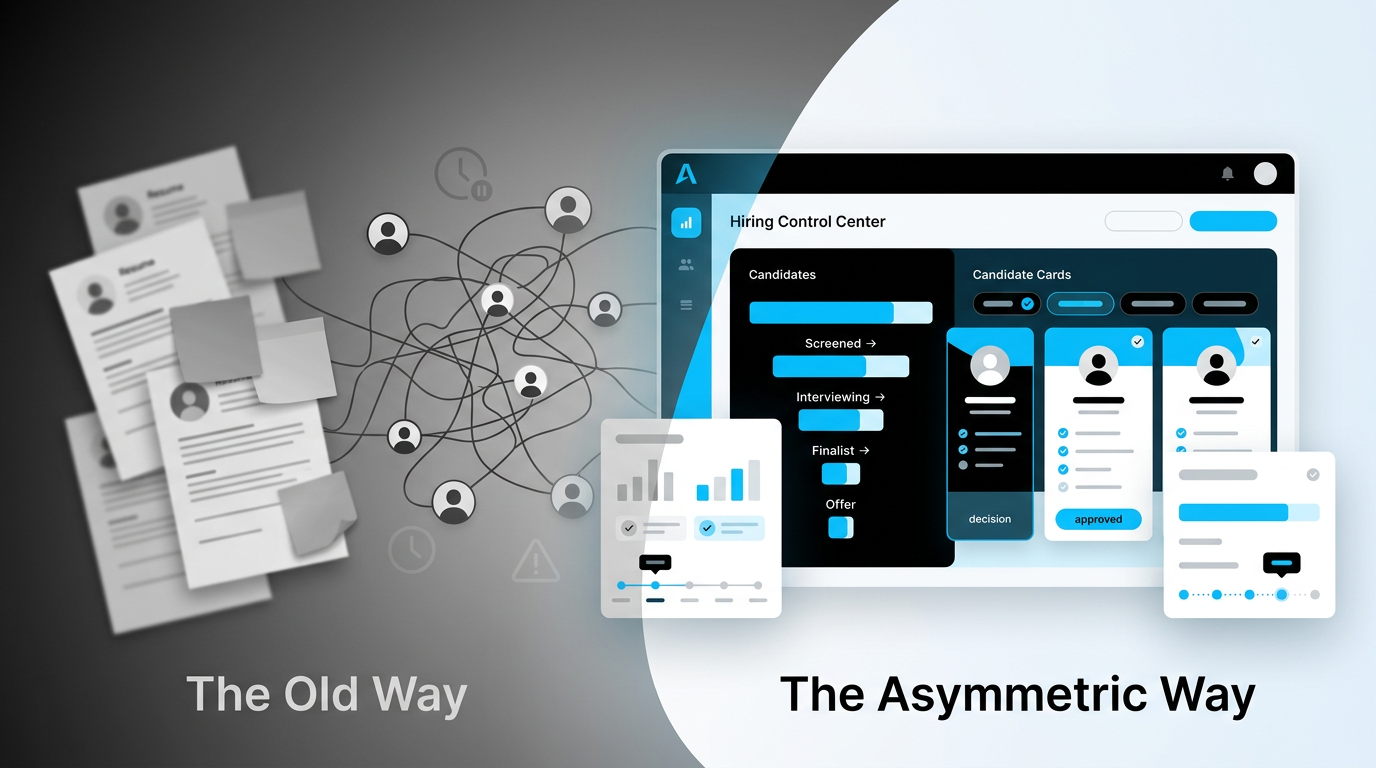
The entire process is visible to our clients in real time through our client portal. Not a weekly email. Not a vague status call. A live window into the pipeline: who has been identified, who has been contacted, who has responded, what the market is saying, and what the data recommends. We made the case for why real-time visibility is a hiring outcome driver in Lack of Process Transparency & Real-Time Visibility and No Single Source of Truth for Collaboration or Updates.
Most recruiters disappear into the process. We invite you into it.
The Science Behind the Shortlist: Closing Every Gap Before the Interview
Here is where most search firms, even retained ones, leave the door open. They source well. They engage well. They present a shortlist. Then they hand the client a resume, a phone screen summary, and a gut feeling.
That is not intelligence. That is hope wearing a suit.
Asymmetric Talent Solutions uses the TTI Success Insights TriMetrix HD, a multi-science behavioral assessment that provides what no resume or interview alone ever can: a complete psychological blueprint of how a person behaves, what drives them, how they think, and whether their competencies align with what the role actually demands.
This is not personality profiling for curiosity’s sake. This is a job-benchmarkable, bias-free, EEOC-compliant scientific instrument validated for selection, matched to role requirements, and delivered before the client ever meets a finalist. The TTI TriMetrix HD produces a complete comparison of candidate profiles against the documented requirements of the position, before a single offer conversation begins.
We are certified TTI Success Insights consultants. That designation means we deploy these instruments correctly, interpret them at depth, and integrate them into steering client decisions. Where other firms give you a resume and a feeling, we give you a case.
We went deeper on the failure of the traditional screening model in Screening Beyond the Buzzwords and Candidate Qualification and Assessment. Without behavioral science, every hiring decision is built on incomplete information, and the risk is absorbed entirely by the client.
Technical Validation: The CTO Layer
Behavioral alignment tells you how someone will operate. It does not tell you whether they can actually do the work.
Most search firms, including most retained firms, do not have the capability to validate that. They present candidates who look right on paper, test well behaviorally, and interview confidently, then leave the technical validation entirely to the client. This creates a hidden gap between the search process and hiring confidence, particularly in technology, infrastructure, AI, cybersecurity, and software roles where competency cannot be inferred from a job title or a degree.
We close that gap.
Asymmetric Talent Solutions operates with an in-house CTO who validates candidates at the technical level, on demand. This is not outsourced. Not a vendor. An embedded technical authority inside our search process: a practitioner who has worked in the environments our candidates are being hired into, who can probe competencies in real depth, and who produces a technical assessment that accompanies every shortlisted candidate profile.
The result is a shortlist where every finalist has passed four independent evaluation layers: surgical sourcing, deep discovery alignment, multi-science behavioral assessment, and technical validation. No gap. No assumption. No version of “seemed strong in the interview” that hasn’t been stress-tested before you meet them.
When you receive a finalist from Asymmetric Talent Solutions, you are not receiving a candidate who made it through a resume screen and a phone call. You are receiving a finalist-level slate of qualified, interested, and assessed talent that has been sourced from the full addressable market, engaged with precision, assessed behaviorally, validated technically by a domain expert, and presented with complete supporting intelligence.
Traditional staffing sells hope and hides the process. We deliver outcomes and show you the receipts at every step.
The Numbers Behind the Process
This is not positioning. This is a performance record.
Asymmetric Talent Solutions has maintained a 100% completion rate on every committed search since inception. Every search we have agreed to conduct has been completed. Not most of them. Every single one.
We re-map every completed search, a second surgical pass to ensure we identified every viable candidate in the addressable market. The result: a 1% variance on average between the initial map and the re-map. When your average talent pool exceeds 500 profiles, a 1% variance is statistically negligible. The reason we collect and share that data is simple: it proves something the contingent model cannot. We know exactly what we did, how we did it, and that it was complete.
The fastest fully retained search in our history closed in 15 business days. A recent multi-hire engagement, multiple roles running simultaneously, was completed in 16 business days with 75 minutes of total client time invested. The industry average for an executive-level search runs 90 to 120 days. We are not faster by a matter of weeks. We are faster by a matter of months.
The fee is market-aligned. The structure is different. The service is different. The outcomes are categorically different. The investment is not a premium for a fancier version of the same process. It funds a completely different one.
The Problem Is So Old, Most Don’t Believe the Solution Exists
Here is the hardest part of what we do. Not the sourcing. Not the engagement. Not the precision of the work. The hardest part is this: when you tell a hiring leader that you have never failed a committed search, that your clients invest three hours per search, that your talent pools routinely exceed 500 profiles on the first pass, and that your fastest retained search closed in 15 business days, the first reaction is almost always skepticism.
Not because the data isn’t real. Because the problem is so normalized, and the bar has been so consistently low, that most hiring leaders do not believe this level of performance is available to them.
They’ve been conditioned by years of “we’re working on it.” By agencies who went silent between updates. By resume stacks with three names they already knew. By searches that dragged four months and still didn’t close. They’ve adapted to disappointment and called it process.
We wrote about exactly this conditioning, and why the hiring experience most leaders accept is the one they were trained to expect rather than the one that is actually possible, in Settling on Talent.
You opened your last search expecting to settle. And you probably did.
Not because the right talent didn’t exist. Not because the market was impossible. Because the model you trusted was structurally incapable of finding them.
Everybody promises the right hire. We prove it before you make one.
If this article describes the last search you ran, the next conversation costs nothing. The same cannot be said for skipping it.
Schedule a confidential 30-minute brief
Evolution Demands Adaptation
The contingent model was built for a different era: a time before passive talent was the dominant segment of the market, before real-time visibility into search execution was technically possible, before a firm could map 500+ candidate profiles surgically and engage them with personalization at scale.
That era is over.
SHRM data shows that 69% of organizations still report difficulty recruiting for full-time positions in 2025. 75% struggled to fill full-time roles due to technical and soft-skill gaps. The occupational mismatch problem, where the skills employers need don’t align with what the active talent pool offers, is structural, documented, and growing. This is not a talent shortage. It is a sourcing model that has never reached the 70% of the workforce capable of solving it.
We’ve covered the failure of legacy models comprehensively across our Basic Recruiting Stuff series, examining exactly where the traditional process breaks down, in plain language, with data, and without apology. We’ve covered it across our expanding Problems We Solve series: over 50 documented problem categories across speed, access, transparency, structure, and candidate engagement. The evidence is not ambiguous.
The answer isn’t another agency. It isn’t a longer vendor list. It isn’t a wider net cast into the same shallow pool everyone else is fishing in.
The answer is a partner who operates a talent acquisition ecosystem designed, tested, and continuously optimized to produce outcomes that the old model, regardless of effort or intention, cannot reach.
We are not an agency. We are not a staffing firm. We do not take job orders. We do not grade your search against twelve others on a whiteboard.
We are a precision headhunting operation with a 100% success rate on every search we’ve ever committed to. A partner who doesn’t disappear between updates.
Built for clients who are done settling.
– Michael Russo, President
Asymmetric Talent Solutions. Precision Technical Headhunting Solutions, Powered by Data.
100% U.S.-Owned and Operated.