Firms with No TA Infrastructure: When HR Wears Every Hat
- Case Studies
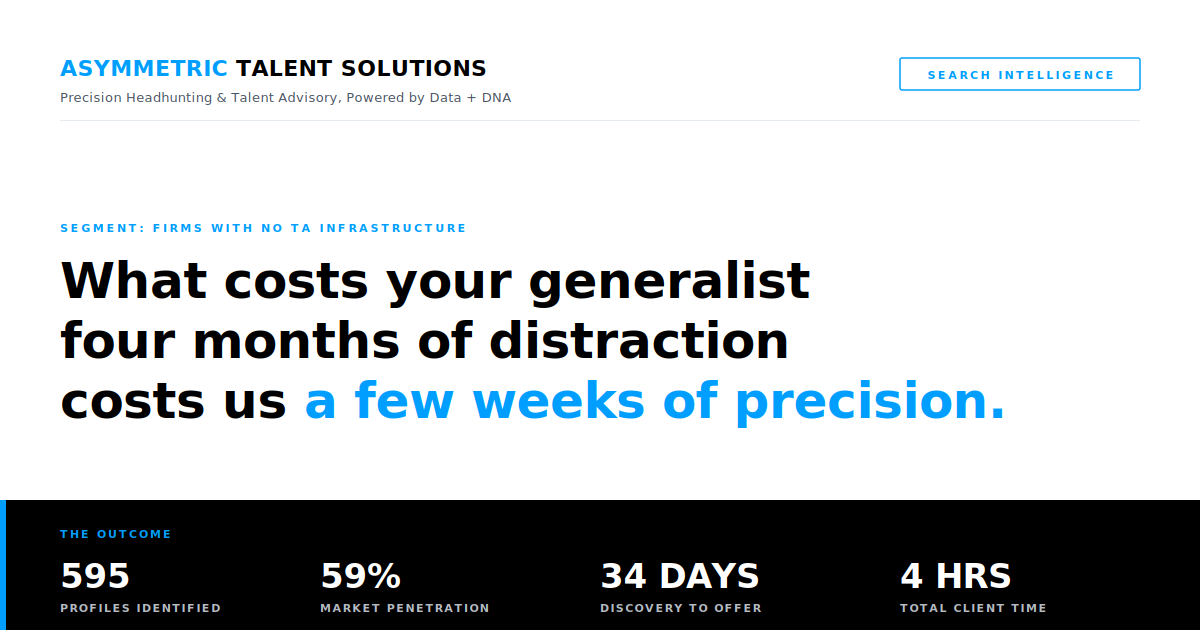
What costs your generalist four months of distraction costs us a few weeks of precision.
No dedicated recruiting function. A lean HR team already wearing every hat: benefits, compliance, onboarding, and now this. Post-and-pray is the default, not by choice but by bandwidth. The question is not whether your team is capable. It is whether pulling them off the work they were hired to do is the best use of the next 90 days.
A search the client could not have run themselves. Not because they lacked talent. Because they lacked the bandwidth to lose.
When the role opens, leadership has two options.
The client is a relationship-driven specialty managed services provider serving as the dedicated IT department for a top-10 Connecticut public school district. They run lean, by design. There is no internal talent acquisition function. When a senior, mission-critical role opens, leadership has two options: pull a generalist off their actual job for four months, or hire a partner who has already done the mapping, the engagement, and the assessment a thousand times before. They picked the second option. This is what that decision returned.
Segment Definition
Post-and-pray is the default, not by choice but by bandwidth. The question is not whether your team is capable. It is whether pulling them off the work they were hired to do is the best use of the next 90 days.
For firms with no TA infrastructure, ATS replaces the entire recruiting workflow as a managed service. Market mapping, multichannel outreach, deep screening, behavioral assessment, and finalist evidence packaging. None of it has to be built, learned, or executed in-house. All of it is included.
The conversion rate from sourced pool to placed hire on this engagement was 0.17%. One in 595.
That is not a recruiting problem. That is a market reality. The internal-generalist version of this search runs the wrong query, gets a thin board response, and after four months either compromises on the requirements or loses the role to a wider competitive market. The math below is what each path actually delivered.
4 months. 1 distracted generalist. 50 to 100 LinkedIn applicants. A compromise hire.
Job posted to the major boards. Inbox fills with the wrong profiles. The HR generalist is now spending half her week reviewing resumes instead of running benefits open enrollment. The role drifts. Leadership eventually settles for the closest fit, or pulls the search and starts over.
34 business days. 4 client hours. 595 profiles mapped. The right hire, evidence in hand.
Full market sweep. 334 candidates engaged. 8 deep-screened against the actual requirements: hands-on technical depth, multi-site team leadership, K-12 industry context, and acceptance of a fully on-site, school-calendar schedule. Behavioral assessment on the finalist before offer.
A four-way intersection that almost no one stands at.
This was not a sourcing problem solvable with a wider net. It was a calibration problem. The role required a candidate sitting at the intersection of four traits that rarely co-occur in a single profile: deep K-12 industry context, hands-on senior technical capability, multi-site team leadership, and willingness to accept a fully on-site role on a fixed school-day schedule. The internal-generalist version of this search would not have known the intersection existed until month three of a posted-role process.
K-12 industry context AND hands-on senior tech
Most senior K-12 IT professionals migrate into administrative or director-track roles where hands-on work disappears. The candidates who retain deep Tier 3 technical capability typically exit K-12 for higher-paying private sector or MSP work. The hybrid who stays both technical and educational is structurally rare.
Multi-site team leadership AND 100% on-site, fixed schedule
Senior technologists with team-leadership reps in 2026 expect hybrid flexibility. The role required full on-site presence, four days minimum across multiple buildings, on a 7:00 to 3:30 school-day window. That single filter eliminated a meaningful share of otherwise qualified candidates before any other criterion was applied.
595 profiles. Three structural groups. Each with a reason most members were not viable.
Of 595 profiles identified, 564 met minimum addressable criteria. The pool composed primarily of three groups, each with structural reasons most members were not viable.
K-12 District-Embedded Technologists
Network Administrators, Systems Engineers, Technology Coordinators, IT Managers at non-conflict districts and Boards of Education.
Highest cultural fit. Lowest mobility. Most were locked into multi-year district employment cycles or had no incentive to leave a stable role.
MSP Site Leads & Senior Engineers
Already serving school districts or municipalities through other MSPs. Strong technical match.
Highest competitive risk: many were locked into client-account assignments or non-compete dynamics that disqualified outreach without significant friction.
Campus-Style Multi-Site IT Leaders
IT leaders for colleges, hospitals, and large non-profits within radius. 500 to 2,000 user environments with small teams.
Domain fit gap on K-12 calendar rhythms, FERPA expectations, and student-facing context required deeper screening.
595 profiles compressed to 1 placed hire through eight gates.
The funnel is the work, not the optics. Each stage represents an intentional gate, not natural attrition. Every cut produced documented evidence: written candidate intelligence, video interview summaries, behavioral assessment data, and structured rationale.
What 57 declines told us about the brief.
Of the 334 engaged, 57 declined with documented reason. The remaining 277 either advanced or remained in pursuing or unreached status at close. The decline pattern is itself market intelligence.
| General / Unspecified | 44 |
| Work Requirements (commute, on-site, schedule) | 6 |
| Career Alignment | 3 |
| Compensation / Package | 2 |
| Timing | 1 |
| Disqualified | 1 |
| Turned Off (culture, employer brand) | 0 |
Zero candidates declined for employer-brand or culture reasons. The client’s reputation in the market is intact and was reinforced through every engagement. The market was not avoiding the company. The work-requirements filter (commute, on-site, school-day schedule) accounted for the largest specific objection and confirmed the constraint was real.
K-12 and MSP-embedded technologists demonstrated unusually high tenure stability. Most qualified candidates were not actively seeking. The 59% market penetration was achieved through surgical, multichannel outreach, not job-board response. This is the difference between active and passive talent acquisition, and it is the structural reason a generalist cannot replicate the result.
Compensation friction was negligible at 2 of 57. The brief was correctly priced. The role was correctly framed. The methodology found the right human inside a constraint stack the internal team would not have known existed.
Discovery to accepted offer in seven weeks.
Discovery on March 10, 2026. Offer accepted on April 24, 2026. Inside that window, the client invested four total hours. Every artifact, video, stakeholder comment, and direction lived in the ATS client portal. The lean HR team was not pulled into resume review. The senior leadership team was not pulled into screening calls. The work happened where the client controlled when they engaged with it.
Discovery & Calibration
Kickoff March 10. Client brief captured. Behavioral plus technical benchmark drafted. Exclusion list confirmed.
Market Mapping & Sourcing
595 profiles built across districts, MSPs, and adjacent verticals. 564 addressable. Live talent map deployed.
Engagement & Screening
334 candidates engaged. 8 deep screened. Long list refined to 4 with executive summaries.
Short List & Client Stage
2 short list presented. Finalist advanced through CEO, COO, and Director of Client Services interviews.
Behavioral Assessment + Offer
TriMetrix HD complete. Offer extended and accepted April 24, within client compensation envelope.
Behavioral evidence on the finalist, before the offer was extended.
A firm with no TA function does not have access to validated behavioral assessment infrastructure. Most do not know it exists. Industry-standard searches do not include it. ATS does, on every finalist, on every committed search.
TTI TriMetrix HD Executive Assessment
This is the work that separates a placed candidate from a successful hire. Before the offer was extended, the finalist completed a full TTI TriMetrix HD assessment. The deliverable to client leadership was a written executive report covering role fit, cultural alignment, decision-making patterns under pressure, communication style, motivational drivers, and a 90-day onboarding and management playbook.
The client did not have to know what TriMetrix is or how to administer it. They received the finished evidence package as part of the engagement.
DISC
Behavioral style under pressure.
12 Driving Forces
Motivators and decision drivers.
25 Acumen + 25 Competencies
Capacity and capability dimensions.
Performance against the standard, not against the average.
Industry benchmarks drawn from AESC, SHRM, and adjacent talent acquisition research. The ATS column reflects this engagement and the firm’s documented performance across 1,000+ completed searches.
| Metric | Asymmetric Talent | Industry Average |
|---|---|---|
| Time to Offer | 34 business days | 90 to 120 days |
| Talent Pool Depth | 595 profiles | 50 to 100 profiles |
| Market Penetration | 59% | 15 to 20% |
| Client Time Investment | 4 hours total | 15 to 25+ hours |
| Cold Outreach Open Rate | > 65% | 15 to 25% |
| Behavioral Assessment on Finalist | Standard inclusion | Rare or absent |
| Search Completion Rate | 100% | ~60% |
What the client received. What it would have cost them to do it themselves.
For a firm with no internal talent acquisition function, the deliverable list below represents the entire ecosystem of work that would otherwise have to be built, learned, and executed by a generalist whose actual job is something else. Compensation analysis, market mapping, multichannel outreach infrastructure, behavioral assessment, finalist evidence packaging, client-facing reporting. None of it is optional for a search of this caliber. All of it is included.
Full-market talent map
595 profiles identified across the addressable commute radius. 564 addressable. Mapped by current employer, title, geography, technical depth, and leadership scope. Delivered as a live, navigable artifact.
Multichannel candidate engagement
334 candidates engaged through email, LinkedIn, phone, and direct messaging. 59% penetration of the addressable pool. Each engagement documented with response, interest, decline reason, and pipeline status.
Compensation and market intelligence
Cross-referenced market compensation analysis against the client envelope. Documented commute, schedule, and work-model friction patterns. Captured candidate-side context on K-12 vs. MSP vs. campus career dynamics.
Long list and finalist evidence
4 long-list candidates with video interviews, executive summaries, technical assessment notes, and reference framework. 2 short-list finalists with full documentation. Client review time under 4 hours total.
TriMetrix HD behavioral assessment
Complete TTI TriMetrix HD profile on the finalist, including DISC, Driving Forces, acumen, and 25 competencies. Translated into a written executive report covering fit, risks, and a 90-day management playbook.
Closed within compensation envelope
Offer extended within the client’s documented range. Within budget. Above market median for the geography. Single-cycle close, no second search required, no compromise on the brief.
If this looks like your firm, we should talk.
You do not need to build a recruiting function. You need to rent one that already works. Three ways to start. Each routes directly to Michael Russo. No gatekeepers.