Nobody Went and Got Them
- Blog
I have been in this business since 2009. Long enough to know exactly how it works and long enough to have no excuse.
When I started Asymmetric, we ran contingent work. Not as a legacy holdover. On purpose, as a real line of business.
Our fill rate was 28.5 percent. Above the industry average. We still failed three out of four searches.
I thought that was a bad run. It was the ceiling.
So we killed it. Not because we were losing at it. Because we were winning at it, and winning still meant most clients ended exactly where they started.
Now here is the part you are not going to like
You made your last hire without seeing most of the available talent. Nobody told you that. You did not approve it, you were never asked, and you signed off anyway, because the shortlist arrived and the seat was open and three names felt like a decision.
You opened that search expecting to settle. You probably did. And when it ran long you called that a tight market, when the actual answer was that nobody went and got the people who were not looking.
You have adapted to disappointment and started calling it process.
That is not a failure of judgment. It is the model working exactly as designed. It is built around your inability to audit it. You cannot see the market, so any list looks like the market. You cannot see the outreach, so forty emails looks the same as four hundred. You cannot see the screen, so “great culture fit” passes for analysis. You cannot see the pool, so when the search dies they tell you the talent does not exist.
It exists. Nobody went and got it.
None of that is a character flaw in the people doing it. Plenty of good recruiters work inside that structure and finish, and finish often. They finish in spite of it. The structure has trained you to expect so little that when someone returns a call, you think you found a good one.
So we built the opposite.
What that looks like
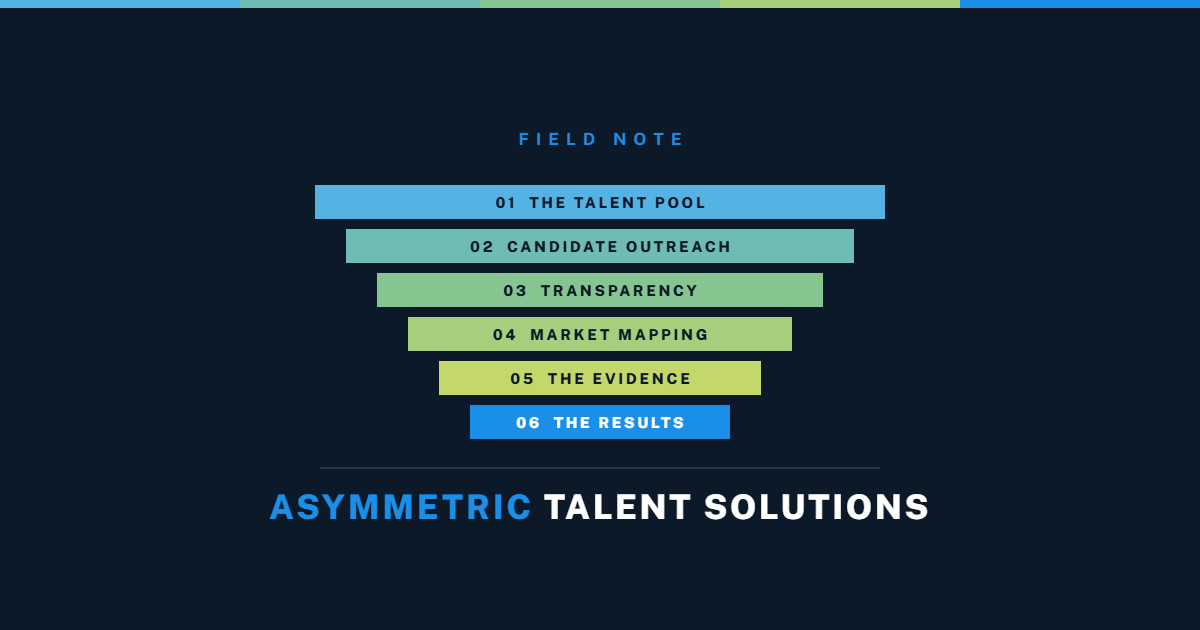
The first thing you get is not a resume. It is the market. Before a single message goes out, the addressable pool for that seat is mapped, indexed, and tiered against the real profile. If the market is 41 people, you will know it is 41 people, and you decide whether the seat you wrote is real. Most firms never have that conversation with you, because a small market means a hard search and nobody is paid to tell you that.
Pools average ~600 profiles per completed search. We engage 60 to 70 percent of that market in two directions, meaning they answered. Industry data from AESC and SHRM puts contingent pool reach at 15 to 20 percent.
Then every completed search gets re-mapped and the variance published. It averages 1 percent. That is the only proof that exists that the first pass was complete.
Finalists clear four independent evaluation layers, including technical validation by our in-house CTO and behavioral science through TriMetrix HD, instead of a phone call and a gut read. We do not pitch candidates. We build cases.
Your total time inside all of it runs under four hours.
The record gets published afterward. Every stage, sourced to placed. Declines included. Long searches shown at the length they took. 100 percent completion on every committed search.
Why it matters
The hire is not the deliverable. The certainty is. When you know you saw the whole board, you stop wondering whether the third candidate was the best one or just the one who answered.
I am not for the buyer who wants it cheap and fast. That search becomes somebody’s problem again in eight months when the hire walks.
I want the one who has been burned, who already knows how the box works, and who is finally angry enough to ask for the receipts.
Traditional recruiting is a leap of faith. We are a paper trail.
Everybody promises the right hire. We prove it before you make one.
Michael Russo
President, Asymmetric Talent