The Fee Is the Small Number
- Blog
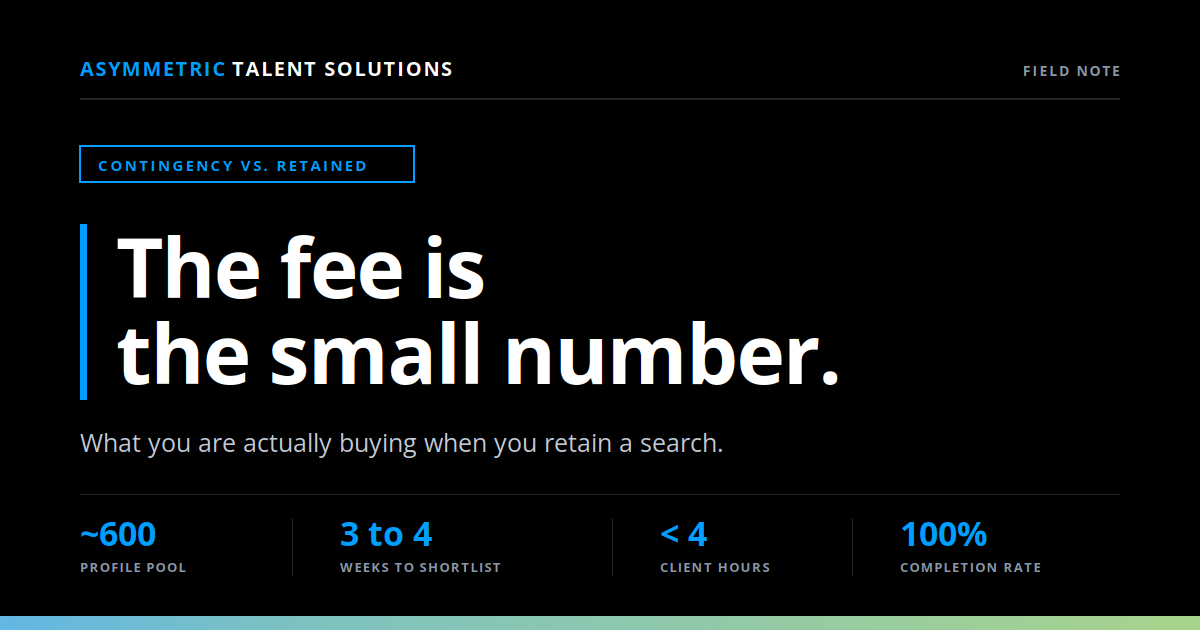
The fee is the small number.
What you are actually buying when you retain a search, and why most companies have been buying the wrong product for years.
Contingency pays for speed. Retained pays for accuracy.
Those are two different products sold at two different prices, and most buyers do not realize they have been purchasing the wrong one. Not because they made a bad decision. Because nobody ever laid the two models side by side and explained what separates them.
Here is that explanation.
Four numbers that decide whether the search closes.
The economics nobody says out loud.
A contingency recruiter gets paid only if their resume beats the other three firms’ resumes to your inbox. So the model rewards speed and volume. Fit is not something it is built to reward, because no mechanism inside it pays anyone to do the slow work.
Our own FAQ says it plainly: a contingent agency juggles 10 to 15 roles at once, all at no cost to them until placement. Your search gets ranked by difficulty and profitability, then worked in whatever order gets someone paid fastest. In that arrangement you are not a client. You are a lottery ticket.
This is a structural problem, not a character problem. Plenty of people running contingent desks are talented operators. The model they work inside cannot pay them to run a real search, so they run the only search it funds.
Paid on speed. Priced on hope.
Multiple firms racing the same role. Candidates limited to the people who are actively looking and who agreed to be shopped around. No commencement fee, no shared accountability, no obligation to finish. When the search stalls, the desk moves to the next role on the whiteboard and you start over from zero.
Paid on process. Priced on evidence.
One firm, exclusive in both directions. The full addressable market gets mapped and engaged, including the people who will never see a job post because they are busy doing the job. Milestones with deliverables attached. When the market tells us something inconvenient, you hear it that week.
Exclusivity in both directions. We stop selling and start searching. Your role gets worked every day, not when it becomes convenient.
Access to people who are not looking. Contingency can only present candidates who are active and who have agreed to be shopped to multiple firms. That is the visible slice of the market. The technical leader you actually want is employed, busy, and building something. Reaching that person takes weeks of work nobody does for free.
Full market coverage instead of a first-five-resumes sample. Talent pools on our completed retained searches average ~600 profiles, with 60 to 70% of that pool engaged.
A fee structure that stays honest. Retained search runs 33% of first-year guaranteed cash, split across three milestones: commencement, shortlist, and completion. You never pay for the whole thing before the work starts, and every milestone has a deliverable attached to it.
When a prospect pushes back with “why would I pay before I see results,” the answer is short. You are not paying for a resume. The purchase is market intelligence, and it tells you whether the role you wrote is even hireable at the compensation you set. If it is not, you find out in week two instead of month five. That information is worth the engagement by itself.
What the process actually feels like from your side of the table.
Most recruiters disappear into the process. We invite you into it.
Here is the sequence, week by week, so you can picture it before you commit to it.
Benchmark the job before assessing a single person.
We run TTI’s patented job benchmarking process. The role gets assessed first. What behaviors, driving forces, and competencies does this job actually reward? Not the wishlist your last VP wrote in 2019. This is the step nearly everyone skips, and skipping it is why most searches drift.
You get the market map.
Target company list. The universe of qualified people. Where we are going and why. You approve it before we move. Nothing about the search is a black box, and you are not waiting on a status email to learn what we found.
Intelligence, not status theater.
You get who we contacted, who passed, and why they passed. If three people in a row tell us your compensation band sits under market, or that your Glassdoor page is costing you conversations, you hear it that week. Most firms bury that feedback because it is uncomfortable. We hand it to you while you can still do something about it.
The slate.
Resumes are not what arrives. You get cases. Every finalist comes with a written evidence file and TriMetrix HD results (DISC, 12 Driving Forces, Acumen, and competencies) scored against the job benchmark. You will know how the person thinks, what drives them, and where the gaps sit before you ever shake a hand.
Read that again. Industry research from AESC puts typical client time investment at 15 to 25+ hours per search. For a CEO or a CTO with a roadmap to protect, that gap is not a convenience. It is the whole argument.
Risk, reframed.
The fee is not the risk. Your risk is the mis-hire.
If we are negotiating over a search fee, we are arguing about the small number. The big number is a senior technical leader who does not work out at month seven. You lose the salary and the ramp. Two engineers quit under them. The roadmap slips a quarter, and then you run the search again from a weaker position with a nervous board watching.
Leadership IQ research puts new-hire failure at 46% within 18 months. The U.S. Department of Labor and SHRM put the cost of a bad hire at 30 to 200% of annual salary. Those figures are not a scare tactic. They are the actual downside distribution of the decision you are making.
Evidence replaces instinct.
An interview measures how well someone interviews. A job benchmark plus a validated assessment against it measures whether they can do the job.
Decisions become defensible. When your board asks why this person, you have a documented and auditable process instead of “we liked her.”
They see the benchmark too.
The people who are not a fit self-select out early, on their own, before anyone burns a quarter finding out the hard way. That is a large part of why retained placements counteroffer less and stay longer.
Nobody was sold into a job. They were matched into one.
Four hours instead of forty.
Hiring managers on your side spend four hours instead of forty across the whole engagement.
Your recruiters, if you have them, stop chasing a role that was never going to close through a job posting, and go back to the work they were actually hired to do.
| Metric | Asymmetric Talent | Industry / Contingency |
|---|---|---|
| Search outcome | 100% completion on committed searches | 15 to 20% contingent fill rate |
| Talent pool depth | ~600 profiles (avg.) | Limited, active candidates only |
| Talent pool reach | 60 to 70% | 15 to 20% |
| Time to shortlist | 3 to 4 weeks | 8 to 16 weeks |
| Client time per search | Less than 4 hours | 15 to 25+ hours |
| Cold outreach engagement | 60%+ open rate | 15 to 25% |
Industry figures drawn from AESC, SHRM, and adjacent industry research. ATS figures drawn from completed engagements. A fill rate and a completion rate measure the same question, whether the seat gets filled, from opposite ends of the model.
Retention is the only honest scoreboard for a search. Anyone can fill a seat. Keeping it filled is the part the model has to earn.
The bar has been low by design.
The industry spent thirty years training buyers to expect a stack of resumes, a vague update cadence, and a compromise hire at the end of it. Enough companies accepted that outcome that it became the standard. That is not a standard. It is a symptom of a model that never had a reason to do better.
Everybody promises the right hire. We prove it before you make one.
The discovery call takes 30 minutes. By the end of it, you will know whether ATS is the right firm for your search. We will know too.
Three ways to start.
Whether you are opening a business-critical search, evaluating whether the retained model fits the hire in front of you, or just want to see how the work gets documented, pick the door that matches where you are.
Industry figures: AESC, SHRM, U.S. Department of Labor, and Leadership IQ. ATS figures drawn from completed engagements.