Our Search Process Map
- ATS Collateral
How we run a search. Stage by stage. Documented end to end.
Most recruiting firms hand you a logo and a promise. We hand you a process map. Every search we run moves through the same seven stages, in the same sequence, with the same deliverables and the same client visibility. No black box. No mystery. No “trust us.” This is the operating system. The full PDF is below.
Seven stages. One throughline. Documented every step.
ATS Search Process 2026
The complete seven-stage map with timing, deliverables, and the data layer at each step.
Same sequence. Every search. Every time.
No improvisation. No reinvention. The discipline is in the repetition. Here is the entire arc, end to end.
Position Intake
Co-author the search. Scope, comp, must-haves.
Talent Mapping
Full qualified pool sourced and architected.
Talent Engagement
Multichannel outreach. 55-75% reach validated.
Tailored Screening
Recorded interviews, uniform, in portal.
Longlist Presentation
QIA leaders. Client selects. No cap.
Client Interviews
Real-time portal collaboration. No fragmented comms.
Offer Management
Negotiated and closed. 100% completion.
What happens, what gets delivered, and what the client sees.
Every stage has an input, an output, and a portal artifact. Nothing happens in the dark.
We don’t take notes. We co-author the search.
Most firms run a 30-minute intake call and disappear. We sit in the role with you. Expectations, comp range, must-haves, deal-breakers, EVP, internal political dynamics, prior search history, what “great” looks like, and what the role actually has to deliver in year one. Discovery is structured, documented, and signed off before sourcing begins.
The complete qualified pool. Sourced, architected, never capped.
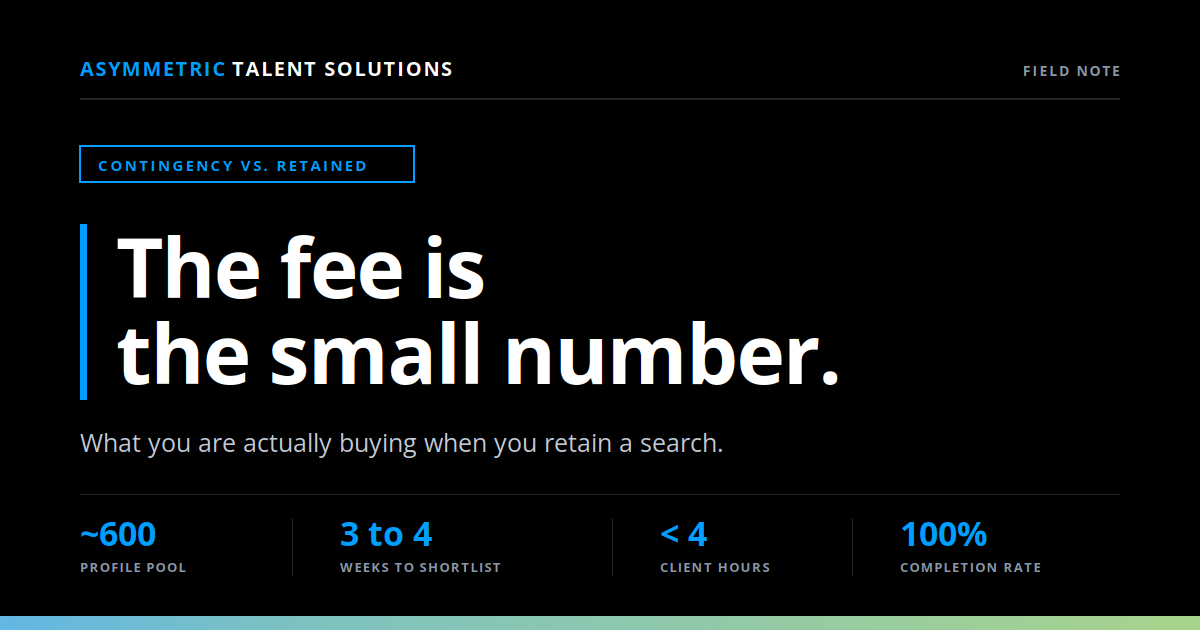
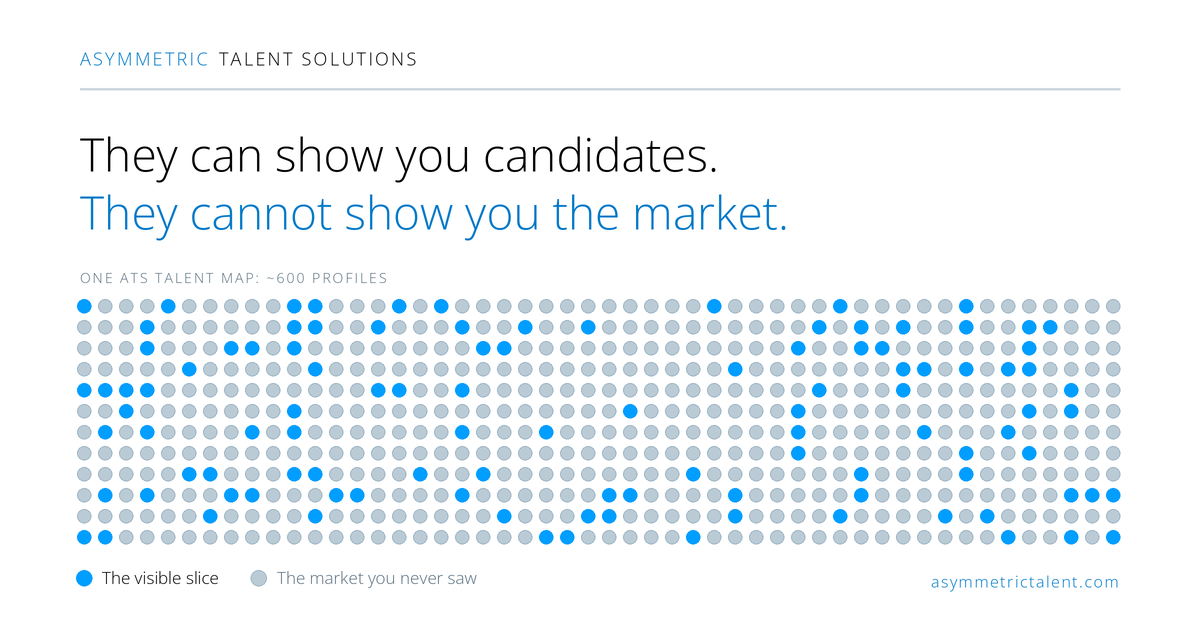
Industry, company, function, geography, level. We do not cap the pool. We source the entire qualified market, however large or specific it needs to be. The average search runs 500 to 800 profiles. Some run more. Some run less. The number is a function of the role, not a quota we hit. The mindset and the promise are the same: every candidate worth our messaging gets it.
The talent map itself is custom. We architect it to the composition of the pool and the criteria the client cares about, not a generic template. Status and progress live in your client portal. The map is delivered through the portal and reviewed live in steering, not stored as a static dashboard tile.
Multichannel outreach. Position-specific. Never copy-paste.
Email, LinkedIn, phone, warm referrals. Every message is written for the role and the candidate, not blasted from a sequence tool. Industry benchmarks land at 15 to 25% pool penetration. Our floor is roughly 60%. Our average runs 55 to 75% reach, validated across all searches and scaling with pool volume. The point isn’t volume. The point is reaching the people who would never reply to a templated note.
Engagement also produces intelligence, not just yes-or-no responses. We track candidate feedback on the search itself, why qualified candidates pass (drives steering decisions), and the actual compensation expectations the market is signaling. The pool tells us what the brief got right and what needs to recalibrate. We surface that in real time.
Tailored screening. Recorded interviews. Uniform across the slate.
Stage 4 is the screening layer of the process. It is tailored to each search, not a fixed checklist. Every engaged candidate moves through an initial conversation, then a formal video interview that is recorded and clipped to the same standardized prompts across the entire slate. Same questions. Same conditions. Side-by-side review in your client portal.
That uniformity is the point. You don’t compare a candidate someone briefed to one someone didn’t. You compare like to like. Where the role warrants it, we recommend layering in TriMetrix HD assessments (DISC, motivators, DNA competencies, acumen capacity) on top of the interview screening. We tell you when, why, and at what depth. Behavioral assessments are optional, priced separately, and used where the search benefits from a deeper data layer.
The QIA longlist. Uncapped. Client selects from it.
We do not pre-cap the shortlist at three or five. We present the complete longlist of leaders surfaced through Stage 4: the most Qualified, Interested, and Assessed (QIA) candidates from the engaged pool. Whoever made it through the screening is presented. The client decides who advances.
Each candidate on the longlist arrives fully packaged: resume, recruiter notes, structured screening clips, comp expectation, motivation profile, behavioral data when elected, and the case for inclusion. Three to four weeks to a decision-ready longlist. The industry runs eight to sixteen. The difference is methodology, not luck. The shortlist that goes into client interviews is yours to build.
Real-time collaboration in the portal. No fragmented comms.
The interview phase is where most searches lose candidates: emails go unanswered, scheduling drags, feedback gets stuck in someone’s inbox, and a top finalist feels the air go out of the process. We solved that by moving interview-cycle communication into the portal. Scheduling, feedback capture, candidate updates, panel notes, and decisions all happen in one place, in real time, visible to the people who need to see them.
The result is a higher and more consistent emotional experience on both sides of the desk. Candidates feel the search team is engaged. Clients feel the process is moving. Nothing falls through the cracks because nothing is fragmented across email threads, side conversations, and lost calendars.
We negotiate. We close it.
Counters, equity, start dates, relocation, resignations, the awkward conversations that derail offers when the recruiter has already cashed the placement check. We stay in the deal until the candidate is onboarded. 100% completion on committed searches isn’t a marketing line. It’s the operating standard.
Steering meetings. Weekly. Every search.
The seven stages run on a single rhythm: a weekly steering meeting between the search team and the client. No status email pretending to be progress. A live, cadenced, data-backed conversation.
What gets reviewed in steering
Pipeline. Penetration. Comp. Friction. Risk.
Live talent map. Pool penetration vs target. Compensation calibration as the market reveals itself. Friction points (geography, equity, relocation). Risk register on each finalist. The portal is open the entire time. You don’t wait for a Friday update. You log in.
Most recruiters disappear into the process. We invite you into it.
The optional behavioral science layer
Some searches benefit from a deeper data layer than the standard screening provides. When a client elects to add TriMetrix HD as part of the engagement, it runs as a lens across the whole search, not a Stage 4 event. We map the role to a target behavioral profile up front. We screen against it during sourcing and engagement. We assess against it at the screening stage. We use it to calibrate the longlist, sharpen interview questions, and onboard the placement against a known operating profile. The data follows the candidate from first touch to first ninety days.
Recommended when the role warrants it. Priced separately. We tell you when, why, and at what depth.
Traditional recruiting is a leap of faith. We’re a paper trail.
The full How We Work narrative goes underneath the map.
This page is the process map. The methodology essay (philosophy, frameworks, the case for behavioral data, the difference between staffing and headhunting) lives one click deeper.
Process is a feature, not a formality.
The recruiting industry got away with opacity for thirty years because the buyer had no comparison set. Black-box sourcing, mystery pricing, vague “we have a network,” and a placement fee on the back end. The whole transaction was structured to keep the firm’s work invisible and the client’s leverage low.
We built the inverse. The map is custom-built and reviewed live. The portal is open. The cadence is weekly. The screening is documented. The completion rate is published. If a search underperforms, the data shows it before the client has to ask. If it overperforms, the data shows that too. Either way, you’re not guessing.
That’s the whole pitch. Not a logo, not a promise, not a “trust us.” A documented, repeatable, accountable system. Every search. Same way. Every time.
ATS Search Process 2026
Print it. Share it internally. Bring it to the next vendor evaluation. Compare it line by line.
Have a search that needs to run this way? Three ways to start.
Retain us, schedule a portal demo to see the process live, or open a no-agenda discovery conversation. All three go to the same inbox.